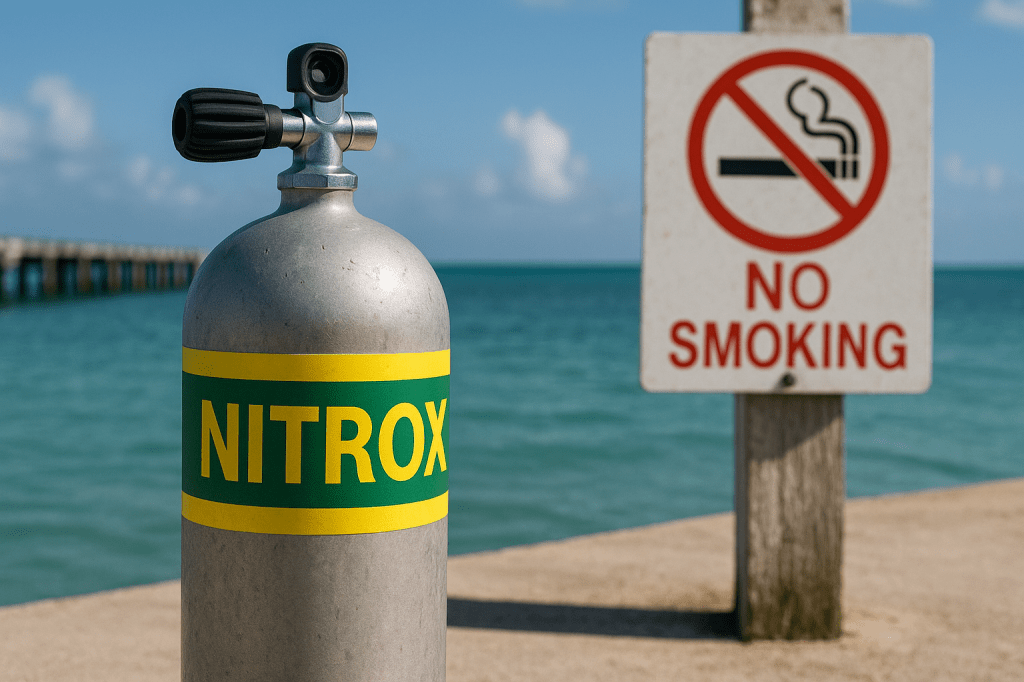
Why You Should Always Handle Nitrox Tanks as if They Contain Pure Oxygen
Nitrox, a breathing gas with elevated oxygen content (typically 22% to 40%), offers scuba divers benefits like extended bottom times and reduced decompression risks. However, its higher oxygen levels also heighten hazards—particularly fire or explosion risks—if not managed carefully. While Nitrox isn’t pure oxygen (100% O₂), treating it as such ensures maximum safety by addressing worst-case scenarios and minimizing errors. Real-world incidents and the perspectives of scuba industry organizations reinforce the value of this cautious approach.
1. Errors in Gas Mixing or Labeling Can Be Catastrophic
Mistakes during blending or labeling can result in tanks containing far more oxygen than intended—sometimes nearing pure oxygen levels. Treating every Nitrox tank as a high-oxygen risk mitigates these dangers.
- Real-Life Scenario:
In 2008, a Florida dive shop mistakenly filled a tank with nearly 80% oxygen instead of the labeled 36% Nitrox. The diver, trusting the label, used it without verifying and narrowly avoided oxygen toxicity at depth. A “pure oxygen” mindset could have prompted stricter checks, catching the error.
2. Elevated Oxygen Increases Fire and Explosion Risks
Even at typical Nitrox levels, the enriched oxygen content makes materials more flammable. A minor leak or spark can ignite a fire, with risks escalating as oxygen concentration rises.
- Real-Life Accident:
In 1997, a 40% Nitrox tank exploded in a California dive shop, injuring two workers. Trace oil from inadequate cleaning ignited under pressure in the oxygen-rich environment. Treating the tank as pure oxygen would have required meticulous cleaning, preventing the blast.
3. Equipment Must Be Oxygen-Compatible
Higher oxygen levels demand “oxygen-cleaned” gear to avoid ignition. While standard Nitrox often works with regular equipment, assuming pure oxygen ensures all gear meets stringent safety standards.
- Real-Life Scenario:
In 2015, a technical diver used a non-oxygen-compatible regulator with 50% Nitrox. An O-ring failure caused a leak at depth, forcing an emergency ascent. Oxygen-safe equipment, mandatory for pure oxygen, would have averted this.
4. Simplifying Safety Protocols Reduces Human Error
In diving—especially technical diving with multiple gas mixes—consistent rules are vital. Treating all Nitrox tanks as pure oxygen eliminates guesswork and reduces oversights.
- Real-Life Accident:
In 2003, a Red Sea dive boat fire destroyed the vessel after a 40% Nitrox tank, stored near a heat source, was mishandled as if it were air. A “pure oxygen” approach would have enforced proper storage, avoiding the disaster.
5. Tank Analysis Isn’t Foolproof
Divers are trained to analyze Nitrox before use, but analyzers can malfunction or be misread. Assuming a tank contains pure oxygen encourages rigorous verification.
- Real-Life Scenario:
In 2019, a Caribbean diver misread his analyzer, believing his tank held 32% oxygen when it was 45%. He experienced early oxygen toxicity symptoms at depth. Treating it as pure oxygen might have prompted a double-check, averting the risk.
Stances of Scuba Industry Organizations
Scuba organizations universally prioritize safety, but their specific guidelines for handling Nitrox tanks differ. Here’s how key groups approach the topic:
- PADI (Professional Association of Diving Instructors):
PADI, the leading recreational diving agency, requires divers to analyze Nitrox tanks before each dive and follow safe handling practices. Their Enriched Air Diver course highlights oxygen safety, including cleaning gear for mixes above 40%, but doesn’t explicitly mandate treating Nitrox as pure oxygen. PADI focuses on practical, standardized safety for recreational divers. - NAUI (National Association of Underwater Instructors):
NAUI emphasizes education and gas analysis in its Nitrox training, advocating for equipment compatibility and careful handling. While they don’t require a “pure oxygen” approach, they encourage conservative practices, particularly in high-risk settings, leaving room for diver discretion. - DAN (Divers Alert Network):
DAN, a diving safety advocate, recommends treating any gas with elevated oxygen as a potential hazard. They advise oxygen-cleaning standards for mixes above 23.5% oxygen, aligning closely with the “treat as pure oxygen” philosophy to prevent accidents and promote best practices. - TDI (Technical Diving International):
TDI, focused on technical diving, mandates oxygen-cleaned equipment for mixes above 40% and recommends it for lower percentages as a precaution. Their rigorous protocols for advanced gas use lean toward treating Nitrox tanks with pure oxygen-level care, reflecting technical diving’s high stakes. - IANTD (International Association of Nitrox and Technical Divers):
IANTD, an early Nitrox proponent, insists on oxygen-cleaning all gear used with Nitrox and handling tanks as if they might exceed labeled oxygen levels. Their technical diving roots drive a strict, cautious stance that mirrors the “pure oxygen” mindset.
Why Not Take a More Relaxed Approach?
Some divers argue that standard Nitrox poses little risk and doesn’t warrant such caution. Yet, incidents like the 1997 explosion and 2003 boat fire reveal the consequences of mixing errors, poor handling, or equipment failures. Organizations like DAN, TDI, and IANTD, with their focus on safety and technical precision, affirm that a conservative approach prevents tragedy.
Conclusion
Treating Nitrox tanks as if they contain pure oxygen is a vital safety strategy, supported by real-world accidents and reinforced by scuba industry organizations. It protects against mixing errors, fire hazards, equipment issues, protocol lapses, and analysis mistakes. While PADI and NAUI emphasize practical safety, DAN, TDI, and IANTD advocate stricter measures closer to this philosophy. Adopting it ensures divers uphold the highest safety standards, keeping the sport both thrilling and secure.
 Motus Aquaticus
Leave a comment