Scuba diving is built on trust.
Parents trust instructors with their children. Students trust dive shops to provide competent supervision. Certifying agencies trust instructors to follow standards designed to keep people alive. And the public trusts the dive industry when it says, “This is safe when done properly.”
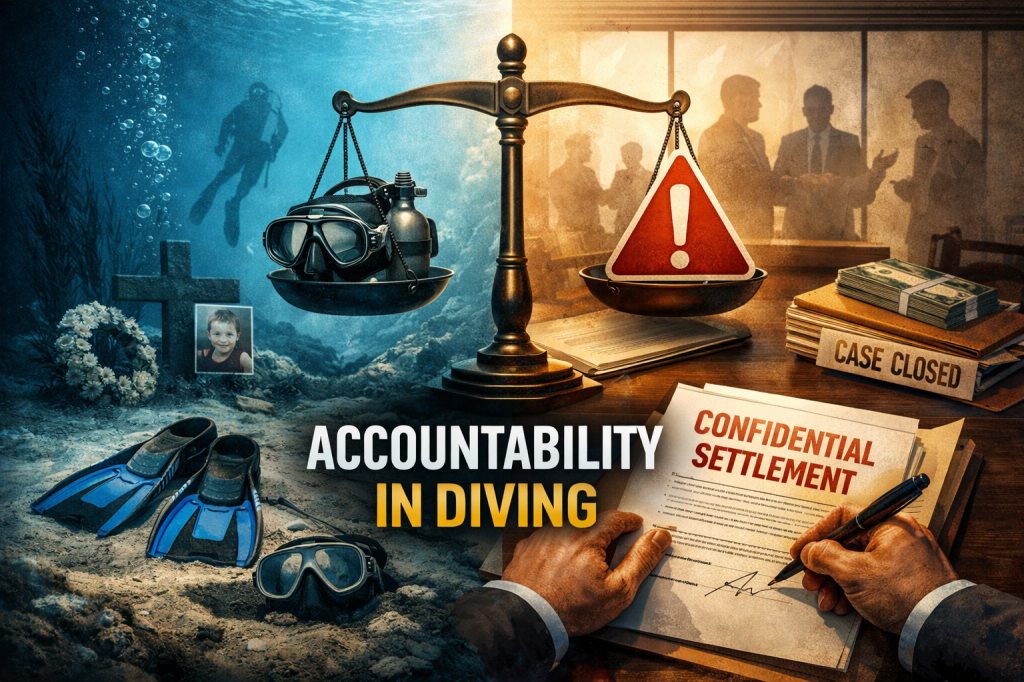
When a student dies under instruction—especially a child—that trust is shattered. Yet time and again, the industry responds not with transparency or reform, but with silence, legal settlements, and quiet returns to business as usual.
That pattern is not just morally indefensible. It is dangerous.
A Pattern We Can No Longer Ignore
Over the years, there have been numerous student fatalities during training dives, including children. Investigations often reveal the same recurring factors:
- Grossly inadequate supervision
- Instructor-to-student ratios that exceed safe limits
- Poor emergency response or delayed rescue
- Ignored medical red flags
- Training environments unsuitable for novice divers
- Deviations from established standards without consequences
Despite these findings, outcomes are depressingly predictable. Civil lawsuits end in confidential settlements. Liability is absorbed by insurers. Instructors quietly move on. Dive shops rebrand. Agencies issue no meaningful public findings. No industry-wide corrective action follows.
When no one is held accountable, nothing changes.
Settlements Are Not Accountability
Legal settlements may provide financial compensation to grieving families, but they do not answer the most important question:
How do we prevent this from happening again?
Confidential settlements actively suppress learning. They prevent instructors, shop owners, and agencies from understanding what went wrong and why. They shield systemic failures from scrutiny. And they allow unsafe practices to persist—often until another preventable death occurs.
An industry that relies on silence instead of self-examination is choosing reputation over lives.
Accountability Is Not About Punishment — It’s About Prevention
Calls for accountability are often met with defensiveness. Some fear witch hunts. Others worry about legal exposure or instructor shortages. But accountability does not mean public shaming or criminalizing honest mistakes.
Accountability means:
- Independent investigation of training fatalities
- Transparent findings that identify root causes
- Meaningful consequences for gross negligence
- Mandatory corrective actions when standards fail
- Industry-wide learning, not isolated blame
Aviation did not become safer by hiding crashes. Medicine did not improve by silencing malpractice. High-risk industries that save lives are the ones willing to examine their worst failures openly.
Diving should be no different.
The Unique Duty of Care When Teaching Children
When children are involved, the ethical bar must be even higher.
Children cannot fully assess risk. They rely entirely on adults to protect them. That places an extraordinary duty of care on instructors, dive centers, and certifying agencies. When that duty is breached through negligence or complacency, the failure is not just professional—it is moral.
If a system allows repeated child fatalities without reform, that system is broken.
Why Certifying Agencies Must Lead
Certifying agencies set standards, issue credentials, and promote themselves as authorities on safe training. With that influence comes responsibility.
Agencies should support:
- Independent fatality review boards
- Mandatory reporting and disclosure of training deaths
- Suspension or revocation processes that are transparent and enforceable
- Public safety bulletins when systemic issues are identified
If agencies distance themselves the moment something goes wrong, their standards become marketing tools instead of safety mechanisms.
Supporting a Real Accountability Mechanism
The dive industry needs an accountability framework that exists outside of litigation and beyond insurance settlements.
Such a mechanism could include:
- An independent, multi-agency safety review body
- Anonymous reporting protections for instructors and divemasters
- Publicly accessible safety findings (without sensationalism)
- Clear pathways for retraining, probation, or removal when warranted
This approach is not radical. It is standard practice in other high-risk activities where lives depend on competence and oversight.
Accountability Protects the Good Instructors
The lack of accountability harms the very professionals who do things right.
When unsafe instructors face no consequences, they undermine public confidence in everyone. When standards are ignored without repercussions, conscientious instructors are pressured to cut corners to compete. Accountability raises the bar—and protects those who already meet it.
A Choice the Industry Must Make
The dive industry can continue on its current path: quiet settlements, closed doors, and incremental tragedies that never quite trigger reform.
Or it can choose courage.
Courage to look honestly at its failures.
Courage to place safety above image.
Courage to accept that accountability is not an attack—it is an obligation.
Every student death under instruction is a signal. Ignoring that signal does not make diving safer. Listening to it might.
If we truly believe that “diving is safe when done properly,” then we must also be willing to confront what happens when it is not—and ensure that it never happens the same way twice.
Lives depend on it!
 Motus Aquaticus
Leave a comment