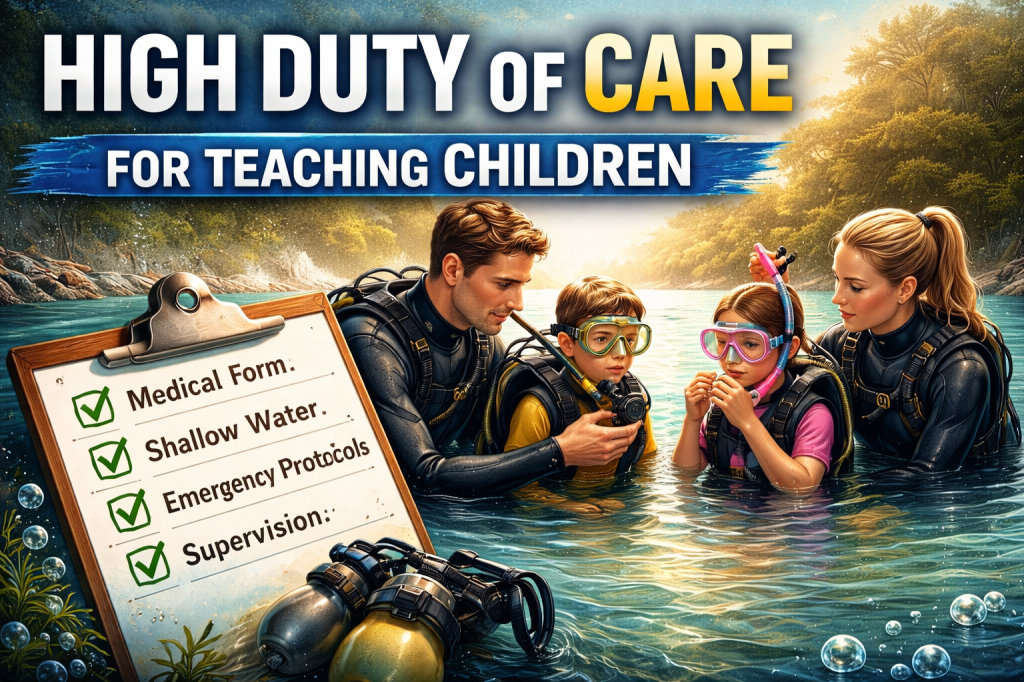
Purpose and Guiding Principle
This High Duty of Care Standard establishes enhanced safety, supervision, environmental, and ethical requirements for scuba instructors, dive centers, and certifying agencies that provide training to minors.
Children are not simply smaller adults. They possess developing cognitive judgment, variable stress responses, and limited risk assessment capacity. Accordingly, instructors who teach minors assume a heightened duty of care that exceeds minimum agency standards.
When training children, minimum compliance is insufficient. Enhanced protection is required.
Safety shall always take precedence over certification timelines, financial considerations, marketing objectives, or parental expectations.
1. Elevated Legal and Ethical Duty
1.1 Instructors teaching minors assume an enhanced duty of care consistent with custodial responsibility.
1.2 All ambiguities in safety decision-making shall be resolved in favor of the child’s protection.
1.3 Commercial pressure, travel logistics, scheduling constraints, or certification goals shall never override safety judgment.
1.4 Instructors act not only as educators, but as primary safety guardians during all training activities.
2. Conservative Supervision Ratios
2.1 Student-to-instructor ratios for minors shall be more conservative than agency minimums.
2.2 Recommended maximum ratios:
- Confined water: 2:1 (children under 13)
- First open water session: 1:1 strongly recommended
- Open water training: 2:1 maximum under all circumstances
2.3 Certified assistants do not replace direct instructor oversight.
2.4 Adult students shall not be combined with minor students in a manner that reduces direct supervision.
3. Comprehensive Pre-Training Risk Assessment
3.1 Mandatory medical screening with strict physician clearance when indicated.
3.2 Additional screening for:
- Respiratory conditions
- Cardiac history
- Neurological disorders
- Anxiety or panic disorders
- Behavioral or attention-related conditions
- Medication usage
3.3 Instructor-conducted readiness interview with both guardian and child to assess:
- Emotional maturity
- Comfort in water
- Instruction-following capacity
- Stress response patterns
3.4 If readiness is uncertain, training shall be postponed.
4. Controlled Environment Selection
4.1 Training sites for minors shall meet enhanced safety criteria:
- Calm water conditions
- Excellent visibility
- Minimal or no current
- Controlled and accessible entry/exit points
- Immediate surface support available
4.2 Children shall not conduct initial training dives in:
- Strong current
- Low visibility
- Overhead environments
- Deep water beyond conservative limits
- Environments requiring advanced self-rescue ability
4.3 Environmental conditions shall be reassessed immediately prior to entry. Deteriorating conditions require cancellation or postponement.
5. Shallow Water Skill Mastery Requirement
5.1 All foundational skill development for minors shall occur in water shallow enough for the child to stand comfortably with their airway fully above the surface.
5.2 “Standable depth” is defined as a depth where the child can:
- Stand upright flat-footed without strain
- Maintain independent airway control
- Regain composure immediately if distressed
- Remove regulator or mask without submersion panic
5.3 No new or complex skill shall be introduced in water where the child cannot immediately stand.
5.4 The following foundational skills must reach demonstrated mastery in standable depth prior to deeper water progression:
- Regulator clearing and recovery
- Partial and full mask clearing
- Controlled breathing under task load
- Basic buoyancy control fundamentals
- Air-sharing drills
- Simulated emergency ascent procedures (confined-water adaptation)
5.5 Mastery is defined as the ability to perform skills:
- Repeatedly and correctly
- Without instructor prompting
- Without visible distress
- While maintaining calm, controlled breathing
- With demonstrated situational awareness
5.6 Advancement to deeper water shall occur only when:
- Skill consistency is documented
- Emotional composure is observed
- The child verbally expresses comfort and readiness
- No panic behaviors have been observed during repetition
5.7 Initial deeper-water sessions shall:
- Introduce no new skills
- Be limited in duration
- Focus exclusively on reinforcing mastered skills
5.8 If regression, anxiety, or performance breakdown occurs, training shall immediately return to standable depth.
5.9 Depth shall never be used as a tool for forced adaptation, compliance, or accelerated progression.
6. Enhanced Supervision Protocol
6.1 Instructors must maintain continuous visual contact and immediate physical proximity during underwater skill execution.
6.2 The instructor shall remain within arm’s reach of each minor student during skill performance.
6.3 Task loading must be developmentally appropriate and incremental.
6.4 Instructors must continuously monitor:
- Breathing patterns
- Buoyancy stability
- Signs of panic or cognitive overload
- Fatigue
- Situational awareness
6.5 Skill progression shall follow demonstrated stability, not a fixed timeline.
7. Emergency Preparedness Standards
7.1 Oxygen delivery equipment shall be present and immediately accessible at all training locations.
7.2 Written, site-specific emergency action plans must be maintained and practiced.
7.3 At least one additional adult certified in CPR/AED shall be present during open water sessions involving minors.
7.4 Instructors must maintain current certification in:
- Child CPR/AED
- Oxygen administration
- In-water rescue techniques
7.5 Emergency drills shall be conducted regularly by dive center staff.
8. Psychological Safety and Autonomy
8.1 Children must never be pressured to complete skills or dives.
8.2 A child may terminate a dive at any time without penalty or embarrassment.
8.3 Any panic response requires immediate stabilization and possible termination of the dive.
8.4 Certification shall not be granted if skills were completed under visible distress or coercion.
8.5 Instructors shall foster an environment of psychological safety where concerns can be expressed openly.
9. Documentation and Transparency
9.1 All deviations from planned training shall be documented.
9.2 Near-miss incidents involving minors must be formally reviewed.
9.3 Guardians shall receive honest and complete debriefings following training sessions.
9.4 Any injury, uncontrolled ascent, emergency oxygen administration, loss of consciousness, or rescue intervention must be formally reported in accordance with agency and insurance requirements.
10. Zero Tolerance for Gross Negligence
The following constitute grounds for immediate suspension and formal review:
- Exceeding safe supervision ratios
- Falsifying training documentation
- Ignoring medical disclosures
- Conducting training in hazardous conditions without justification
- Failure to initiate timely rescue intervention
- Advancing children to deeper water without demonstrated shallow-water mastery
11. Independent Review and Continuous Improvement
11.1 Serious injury or fatality involving a minor shall trigger independent safety review.
11.2 Findings shall inform:
- Updated training standards
- Instructor development programs
- Environmental limitations
- Emergency protocol revisions
11.3 The industry has an ethical obligation to learn transparently from serious incidents involving minors.
Conclusion
Teaching children to scuba dive is a privilege that carries extraordinary responsibility.
Children require enhanced supervision, conservative environmental selection, structured skill mastery in standable water, and deliberate progression only after demonstrated competence and emotional stability.
Certification is not the goal. Safety is.
When instructors accept a child into training, they accept a heightened duty of care that prioritizes protection over profit, prudence over pace, and responsibility over reputation.
Anything less undermines public trust—and places young lives at unacceptable risk.
 Motus Aquaticus
Leave a comment