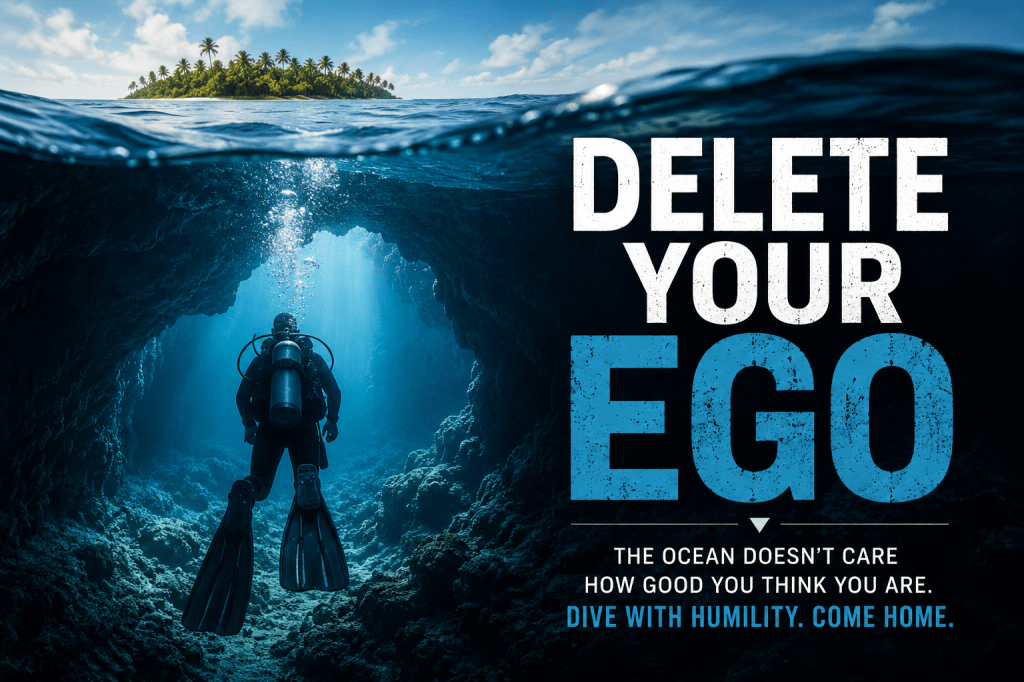
Delete Your Ego Before You Descend
There are countless rules in scuba diving.
Monitor your gas.
Plan your dive.
Dive within your training.
Conduct proper buddy checks.
Respect depth limits.
Maintain buoyancy.
Never hold your breath.
But after years of teaching recreational divers, I’ve become convinced that the most dangerous thing a diver can bring underwater isn’t faulty equipment, bad visibility, current, or even depth.
It’s ego.
Ego is the silent catalyst behind many diving accidents. It convinces divers they are more capable than they really are. It whispers that the rules are for “other people.” It pushes divers to ignore discomfort, suppress fear, impress others, and continue dives they should have aborted long ago.
And once that mindset enters the water, it can start a chain of events that quickly spirals out of control.
The Dangerous Psychology of Diving
Scuba diving is unique because it allows humans to survive in an environment we were never designed to enter. Underwater, there is no room for arrogance. The ocean does not care about your certifications, social media posts, expensive equipment, or how many dives you claim to have.
The ocean only responds to physics, physiology, and reality.
One of the most dangerous cognitive traps in diving is something psychologists call the Dunning-Kruger effect — the tendency for people with limited experience to overestimate their competence.
In scuba diving, this often looks like:
- Newly certified divers believing they are advanced because they completed a few easy dives
- Divers pushing beyond recreational limits because “it felt easy last time”
- People assuming they can handle overhead environments without formal cave training
- Divers believing expensive gear replaces proper education
- Social media divers chasing increasingly risky dives for attention or validation
The frightening reality is that inexperienced divers often lack the knowledge necessary to even recognize how unprepared they are.
True expertise in diving usually creates humility — not ego.
Experienced divers know how quickly things can go wrong underwater.
“Trust Me” Dives
One of the biggest red flags in diving culture is the phrase:
“Trust me.”
“Trust me, it’s an easy wreck.”
“Trust me, the current isn’t bad.”
“Trust me, you’ll be fine at that depth.”
“Trust me, everyone does it.”
“Trust me, you don’t need that certification.”
These dives often begin with social pressure and end with divers entering environments far beyond their actual capabilities.
The problem is that many divers confuse familiarity with competence.
A diver may have survived previous risky dives and begin believing they possess skill when in reality they’ve simply been lucky.
Luck is not training.
Luck is not redundancy.
Luck is not experience.
And eventually, luck runs out.
Ego Creates a Chain of Errors
Most diving fatalities are not caused by a single catastrophic mistake. They are usually the final result of a long chain of smaller decisions.
Ego quietly contributes to nearly every link in that chain.
A diver wants to impress friends.
They ignore discomfort about the dive plan.
They exceed their training limits.
They skip asking questions because they don’t want to appear inexperienced.
They follow more experienced divers into conditions they are not ready for.
They continue the dive despite stress.
They burn through gas faster due to anxiety.
Task loading increases.
Situational awareness collapses.
Panic enters the equation.
At that point, the dive is no longer recreational.
It becomes survival.
The Maldives Tragedy
The recent Maldives cave diving tragedy is a heartbreaking reminder of how unforgiving overhead environments can be. Reports indicate that five Italian divers died while exploring a deep underwater cave system in the Maldives at depths around 50–60 meters (160–200 feet). Investigations and rescue reports suggested the environment was extremely challenging and that the divers may not have been using optimal cave-diving procedures or equipment.
Rescue divers later described the cave as “deep and very challenging,” and reports indicated the group lacked some of the specialized cave-diving equipment typically associated with safe penetration diving, including guideline systems and proper cave protocols.
This is not about criticizing the victims.
Many of them were highly intelligent and experienced individuals. Some had scientific and diving backgrounds.
But intelligence and confidence are not substitutes for disciplined risk management.
Cave diving is one of the most unforgiving forms of diving on Earth because it removes the ability to make a direct ascent to the surface. Once inside an overhead environment, every mistake becomes magnified.
Disorientation.
Visibility loss.
Equipment failures.
Gas management errors.
Narcosis.
Stress-induced breathing rates.
Navigation mistakes.
Any one of these can become fatal.
When ego convinces divers that they can “handle it,” it can override the internal caution that may have otherwise prevented the dive from happening in the first place.
One of the most sobering details from the tragedy was that a member of the group reportedly chose not to enter the water at the last moment — a decision that likely saved her life.
Sometimes the smartest diver on the boat is the one willing to say:
“No.”
The Most Important Skill in Diving
The best divers I’ve ever known all shared one trait:
Humility.
Not bravado.
Not ego.
Not social media fame.
Not expensive gear.
Humility.
They canceled dives without embarrassment.
They turned dives when conditions changed.
They asked questions constantly.
They respected the limits of their training.
They treated every dive site as capable of killing them.
And because of that mindset, they often survived situations that less disciplined divers would not.
The goal of scuba diving is not to prove something.
The goal is to come home.
Delete the Ego
Before every dive, ask yourself a few hard questions:
- Am I diving for the right reasons?
- Am I trying to impress someone?
- Am I ignoring warning signs?
- Do I truly have the training for this environment?
- Is my equipment appropriate and redundant for this dive?
- Would I still do this dive if nobody else were watching?
- Am I comfortable aborting the dive at any point?
Your certification card does not make you immune to physics.
The ocean does not negotiate with confidence.
Every diver — from open water students to technical instructors — is capable of making fatal mistakes when ego overrides judgment.
The best safety device in scuba diving is not attached to your BCD.
It’s humility.
Delete your ego before you descend.


Leave a Reply