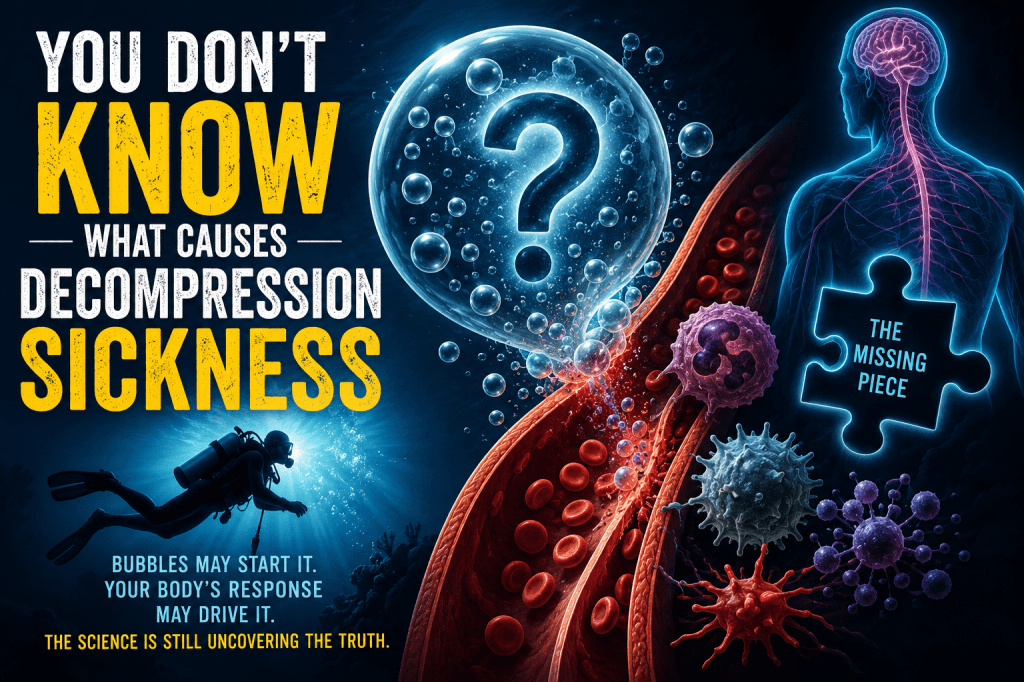
Decompression Sickness: Are We Teaching Divers a Theory as Though It Were a Fact?
For over a century, scuba divers have been taught a deceptively simple explanation for decompression sickness (DCS):
“You came up too fast. Nitrogen formed bubbles. The bubbles caused the injury.”
It’s an explanation every diver recognizes. It’s easy to teach, easy to remember, and partly correct.
The problem is that modern research increasingly suggests this explanation is incomplete.
In fact, one of the most honest statements we can make today is this:
We still do not know exactly what causes decompression sickness.
That statement may surprise many divers, instructors, and even professionals. Yet if we honestly examine the scientific literature, the evidence points toward a disease that is far more biologically complex than simple bubble formation.
The Bubble Theory Begins to Crack
No serious researcher disputes that inert gas bubbles are involved.
But bubbles alone fail to explain many observations.
Why do many divers finish aggressive dives with large numbers of venous gas bubbles and never develop symptoms?
Why do other divers suffer severe neurological DCS after dives that generate relatively few detectable bubbles?
Why can two divers perform identical dives, breathe the same gas, follow the same ascent profile, and have completely different outcomes?
If bubbles alone were responsible, these questions should have straightforward answers.
They don’t.
Even modern decompression theory acknowledges that bubble quantity alone does not reliably predict who develops decompression sickness.
The Real Injury May Begin in the Blood Vessels
Researchers such as Dr. Stephen Thom have spent years investigating what happens after bubbles form.
Their work suggests bubbles may simply be the spark that ignites the injury—not the injury itself.
As bubbles contact the delicate lining of blood vessels, they damage the endothelial glycocalyx and activate endothelial cells. Instead of behaving like passive gas pockets, bubbles become biologically active surfaces capable of initiating vascular injury.
This changes everything.
The disease may not simply be about nitrogen.
It may be about how your body responds to nitrogen.
Your Immune System May Be the Biggest Player
Once endothelial injury occurs, the immune system rapidly joins the process.
Research has demonstrated activation of:
- Complement proteins
- Neutrophils
- Platelets
- Oxidative stress pathways
- Inflammatory cytokines
- Endothelial microparticles
These are not passive bystanders.
They are active participants capable of amplifying tissue injury long after the initial decompression event.
One of Dr. Thom’s most fascinating discoveries involves microparticles—tiny membrane fragments released from stressed or injured cells.
Animal studies have shown that when microparticle formation is blocked, signs of DCS can be dramatically reduced. Even more remarkably, transferring microparticles from decompressed animals into non-decompressed animals can reproduce features of decompression injury. While human disease is undoubtedly more complex, these findings strongly suggest that bubbles are not acting alone.
In many respects, DCS increasingly resembles an inflammatory vascular syndrome triggered by decompression.
Why Symptoms Keep Getting Worse
Every diving instructor has heard it:
“I only had a little tingling when I got out of the water…”
“A few hours later I couldn’t walk.”
That progression is difficult to explain if bubbles are the entire story.
It makes much more sense if bubbles initiate an inflammatory cascade that continues evolving after surfacing.
Activated neutrophils adhere to injured blood vessels.
Platelets aggregate.
Blood flow becomes impaired.
Inflammatory mediators continue damaging tissue.
The immune response may keep the injury progressing even as the original bubbles shrink or disappear.
Then Explain This…
Perhaps the strongest challenge to the traditional explanation comes from freediving.
Freedivers do not breathe compressed gas underwater.
Yet freedivers can and do develop decompression sickness.
The condition known as Taravana, first described among Polynesian pearl divers, has now been documented in competitive freedivers and spearfishermen performing repeated deep breath-hold dives.
Traditional physiology explains this by cumulative nitrogen uptake over many repetitive dives with short surface intervals.
That explanation certainly accounts for many cases.
But it does not answer every question.
Some freedivers develop neurological symptoms after profiles that seem surprisingly modest.
Researchers continue investigating whether altered pulmonary circulation during apnea, endothelial dysfunction, inflammatory responses, vascular shunting, and individual susceptibility all contribute to these injuries.
Again, the evidence points toward decompression sickness being far more than simply “nitrogen bubbles.”
Perhaps Every Diver Brings a Different Body to the Dive
This may be the most important lesson.
Divers often think of decompression algorithms as mathematical.
Human biology isn’t.
Every diver brings a unique vascular system.
A unique immune system.
A unique inflammatory response.
A unique history of previous injuries.
A unique genetic background.
Perhaps this is why identical dive profiles produce dramatically different outcomes.
Maybe decompression algorithms are not just calculating inert gas.
Maybe they are trying to predict the behavior of billions of endothelial cells and trillions of immune interactions that we still do not fully understand.
Humility Should Guide Our Teaching
None of this means dive tables are wrong.
It does not mean dive computers don’t work.
It certainly does not mean we abandon conservative diving practices.
Quite the opposite.
It reminds us that our decompression models are models, not perfect representations of biology.
They manage risk remarkably well.
But they do not explain every injury.
Science advances when we admit what we know—and what we do not.
Today we know:
- Bubbles matter.
- Endothelial injury matters.
- Immune activation matters.
- Inflammation matters.
- Microparticles matter.
What we still cannot say with certainty is exactly why one diver develops decompression sickness while another does not.
Until we answer that question, perhaps the most scientifically honest thing an instructor can tell students is this:
Decompression sickness is not merely a bubble disease. It is a complex biological response to decompression—and we are still discovering how that response works.
The more we learn, the more we realize that the greatest mystery in diving medicine is not how bubbles form.
It is how the human body chooses to respond to them.
References
Authoritative Organizations
Divers Alert Network (DAN). Health & Medicine Resources.
https://dan.org/health-medicine/
Divers Alert Network (DAN). Research.
https://dan.org/research/
Undersea & Hyperbaric Medical Society (UHMS).
https://www.uhms.org/
National Oceanic and Atmospheric Administration (NOAA). NOAA Diving Program.
https://www.omao.noaa.gov/noaa-diving-program
U.S. Navy Diving Manual (Revision 7).
https://www.navsea.navy.mil/Home/SUPSALV/Diving/
Peer-Reviewed Research
Thom SR. Biological effects of decompression. Journal of Applied Physiology. 2011.
https://pubmed.ncbi.nlm.nih.gov/26139218
Thom SR. Microparticles and decompression stress: Connecting the dots. Divers Alert Network.
Lambrechts K, Pontier JM, Mazur A, Buzzacott P. Evidence for inflammatory mechanisms in decompression sickness. Frontiers in Physiology.
https://www.frontiersin.org/articles/10.3389/fphys.2021.660402/full
PubMed Central. Current research on decompression physiology and decompression sickness.
Additional Reading
Divers Alert Network. Decompression Illness: What Is It and What Is the Treatment?
Divers Alert Network. Diagnosing Decompression Sickness.
Undersea & Hyperbaric Medical Society. Decompression Sickness Overview.
https://www.uhms.org/5-decompression-sickness.html
Merck Manual Professional Edition. Decompression Sickness.
Suggested Citation
If you reference this article in academic or professional discussions, please consult the original peer-reviewed publications cited above. The concepts discussed regarding endothelial dysfunction, microparticles, immune activation, and inflammation represent an evolving area of diving medicine research. While inert gas supersaturation and bubble formation remain the accepted initiating events in decompression sickness, the precise mechanisms determining why some divers develop clinical DCS and others do not remain an active area of scientific investigation.


Leave a Reply